Journal
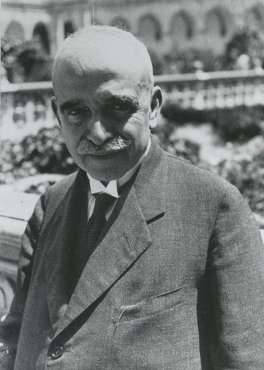
Aby Warburg in Rome, 1928
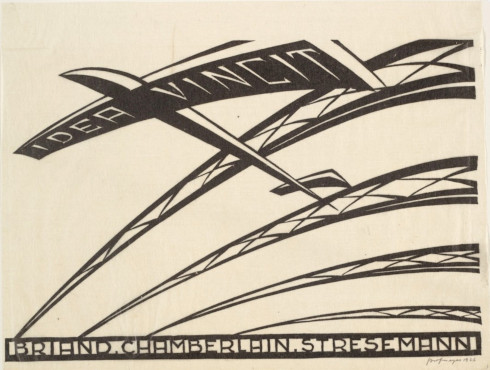
Air mail stamp design "Idea vincit"
Linocut by Otto Heinrich Strohmeyer after a design by Aby Warburg and Otto Heinrich Strohmeyer. Harvard Art Museums/Fogg Museum, Gift of Paul J. Sachs © President and Fellows of Harvard College
In this anniversary year, the Warburg-Haus is taking the initiative and proposing to the Federal Ministry of Finance that a stamp be issued in honor of Aby Warburg
Aby Warburg (1866-1929) was a German art and cultural historian and is today considered one of the most important intellectual inspirers of contemporary humanities and social sciences worldwide. October 26, 1929, marks the 100th anniversary of his death, an excellent occasion to honor this important thinker with a stamp issued by Deutsche Post.
The son of a Jewish banking family, Warburg founded the Warburg Library of Cultural Studies in his hometown of Hamburg. In 1933, several years after his death, the library’s staff were forced into exile in London, where they established the Warburg Institute, which still exists today. His research focused not only on classical art history (including the Italian Renaissance), but above all on the image as a carrier of cultural memory, which Warburg defined as collective social memory. His interdisciplinary approach combined topics and methods from art history, religious history, anthropology, sociology, psychology, and philosophy.
Warburg researched how motifs and expressive pictorial forms could continue to live on even after centuries and develop new effectiveness (keyword: the afterlife of antiquity in modern and contemporary art). He coined the term “picture vehicle” to describe the transfer of artistic images across national and continental borders, initially focusing primarily on prints and leaflets, but also coins, medals, and stamps. Due to his philatelic interests, Warburg even sketched a stamp himself, the design of which he presented to German Foreign Minister Gustav Stresemann in December 1926: Under the motto “Idea vincit” (“The idea wins”), he wanted to use this stamp, which was never realized, to celebrate the Locarno Treaties, for which the German politician and his British and French counterparts Austen Chamberlain and Aristide Briand had received the Nobel Peace Prize in 1925 and 1926.
Methodologically, Warburg developed the iconology that is still authoritative today, responded to the linguistic skepticism of his time with his panel projects (especially the famous Mnemosyne image atlas), overcame the boundaries between high art and popular culture, and — not least because of anti-Semitic hostility and his experiences during World War I – developed the first approaches to an enlightened political iconology, which still inspires us today to critically analyze images from all areas of life — from political propaganda to the flood of images in the so-called new media — in order to prevent visual manipulation. Warburg is also important for the globalization of the humanities, as he was one of the first to appreciate not only European-Western art, but also the visual expressions of other cultures in his observations.
In an age of media images that have become a global social and political challenge and repeatedly lead to conflicts (keyword: the image as a weapon), Warburg’s reflections on an enlightened approach to images and the global transfer of images in politics, advertising, pop culture, and social media offer an important critical approach that is now successfully applied in many sciences around the world and has found a lively following, especially among a younger generation of intellectuals and artists.
(Excerpt from our “Proposal for a stamp for the year 2029”)
Aby Warburg / K.B.W.: Warburg-Haus 1926–2026 / Politische Ikonographie